sábado, 29 de noviembre de 2008

Ideas


La verdad, no se ni siquiera como titular el post, lo que sin duda me imagino es que en un


año esta aca

Smart CCTV could put criminals in the frame even before they strike


The Smart CCTV system – shown here in use in Washington DC – tracks movement, and is programmed to alert operators to certain activities – such as in this case, when the two men are about to meet on a street corner known for drug-dealing


A new generation of 'intelligent' cameras is being pioneered in Portsmouth

The technology is programmed to watch out for certain suspect behaviour or incidents – such as a car going too fast, someone loitering for longer than normal in a car park, or people coming together in known drug-dealing areas – and sends out an alert if it records something suspicious.

The footage can then be monitored by a CCTV operator, who can decide if an offence is being committed.

In the first set-up of its kind in the UK, Portsmouth City Council has installed a system based on behaviour-recognition software to increase the effectiveness of its camera monitoring.

The Perceptrak system, produced by Smart CCTV Ltd of Havant, has been set up to watch quiet areas such as car parks, stairwells or corridors in buildings and streets at night-time.

It effectively allows CCTV staff to monitor more cameras than before because they do not have be constantly watching each screen to see crimes taking place.

Nick Hewitson, managing director of the Havant firm, said: 'When it sees something untoward happening, the system sends an alert to the control room.

'This allows the security officer to make a human decision on whether to monitor the scene and make an appropriate response. It also ensures that many more scenes are being watched than is normally possible.' The system is being provided to the city council for free. The council control rooms have 142 cameras with live monitoring, watched 24 hours a day.

Ray Stead, CCTV manager at the city council, said the decision to install the software followed a successful trial period in 2006.

'The software is an analytical package which you pass information through.

'It analyses what's on it, and throws up an alarm to say "come and look at me".'

Councillor Jason Fazackarley, cabinet member for community safety, said: 'This is a fantastic development. It's the 21st century equivalent of a nightwatchman, but unlike a nightwatchman it never blinks, it never takes a break and it never gets bored. 

'It's an eye in the night. The darkness is no longer a place where criminals can hide.'

jueves, 27 de noviembre de 2008

A pedido de la audiencia

Bah, uno solo, pero hayq ue mantener contento al cliente

los links de Bayes para SPAM y un par de programas free para eso.

As usual en este negocio, no hay garantias

Saludos

http://en.wikipedia.org/wiki/Bayesian_spam_filtering

http://spambayes.sourceforge.net/

http://en.wikipedia.org/wiki/Spam_assassin

http://www.jam-software.com/freeware/index.shtml#spamaware

miércoles, 26 de noviembre de 2008

Se viene la noche

Se viene la noche, y, mas rapido de lo que se pensaba, de paso, los terminos de intercambio?

el ultimo parrafo lo repito para que quede muy claro


“Next year is going to be far tougher for everyone than anything we’re seeing now.”

Cobalt fall reflects slowdown in China

Industrial activity in China has slowed so quickly that demand for cobalt has ground to a halt, according to one of the biggest cobalt miners in the Democratic Republic of Congo, the world’s largest source of the metal.

Camec, the London-listed junior miner, last week mothballed its Mukondo mine, one of the world’s richest cobalt mines, saying it might resume production in early 2009 if prices recover. “It is almost as if there is a buyers’ strike,” said Andrew Groves, chief executive of Camec, referring to Chinese buyers who were buying record quantities of the metal six months ago and sending it to China’s factories to be processed into batteries, propeller blades, magnets and chemicals, among a range of applications so varied that cobalt demand can be seen as a rough proxy of industrial activity.

Cobalt, mined mainly in Congo, has so many uses that demand for it is seen as a proxy of global industrial activity

The freezing effect of the end market on the source market was further confirmed last week when Katanga Mining, a copper-cobalt miner in Congo, suspended its cobalt operations. Like Camec, it will meet reduced demand by selling from current stocks.

Mr Groves described Camec’s cobalt mine as only one victim in a global production chain that is seizing up. Companies such as Samsung have cut production of mobile phones in China, he said, causing a “massive drop-off” in orders for phone batteries that use lithium cobalt oxide, in turn halting metal orders from Chinese buyers in Congo.

Cobalt stockpiles are building up in China and further depressing the price, he said. Trading in cobalt concentrate is opaque but, according to Reuters, the import price in eastern China fell 16 per cent in the week to November 14 and has halved since March. In the week to November 21 it plunged further to about $12 per pound, Metal Bulletin reported.

The cobalt price’s collapse is in line with other industrial metals such as aluminium, zinc, nickel and copper. Miners of these metals daily face crises similar to Camec’s and mothballing mines around the world to save cash as they wait for a price recovery.

A crash in Congo’s cobalt and copper mining industry, however, has as many political as commercial implications. The extraordinarily high grades of copper and cobalt ore in Katanga province have attracted scores of foreign mining companies.

Mining revenues help fund the Kinshasa government, which faces an escalating insurgency in the east of the country. The award of mining licences has been a key negotiating chip in attracting investors to the country and extracting a higher cut of their profits.

Drawn by Congo’s abundance of industrial metals, China was the newest and potentially largest of the country’s foreign investors. In January, the Chinese government signed a resources deal with Kinshasa, valued then at $9bn (€7bn, £6bn), that would grant Chinese companies rights to vast quantities of copper and cobalt in exchange for infrastructure.

But the future of the deal is uncertain in the low-price commodity environment. Also uncertain is the viability of established foreign mining companies in Congo such as Camec.

Shares in these mostly junior miners have “taken a Stuka dive out of the clear skies of the commodities boom”, as a South African mining commentator put it. Camec has fallen 95 per cent to 2.50p over the past six months and First Quantum Minerals has fallen 82 per cent in the same period, while Katanga Mining has fallen 97 per cent.

Camec’s suspension of copper and cobalt mining, Mr Groves said, was simply a prudent business decision. The company would run a scaled-down operation centred on a trucking business that is doing work for the World Food Programme. The Mukondo mine would restart within a week after Camec determines prices have recovered.

“We are monitoring on a weekly basis demand from China,” he said. “Early next year seems like a good guess of when we’ll see demand recovering.” But he cautioned, “Next year is going to be far tougher for everyone than anything we’re seeing now.”


de Ft de hoy

lunes, 24 de noviembre de 2008

Bayes 2

Teorema de Bayes

El teorema de Bayes, enunciado por Thomas Bayes, en la teoría de la probabilidad, es el resultado que da la distribución de probabilidad condicional de una variable aleatoria A dada Ben términos de la distribución de probabilidad condicional de la variable B dada A y la distribución de probabilidad marginal de sólo A.


Sea {A1,A2,...,Ai,...,An} un conjunto de sucesos mutuamente excluyentes y exhaustivos, y tales que la probabilidad de cada uno de ellos es distinta de cero. Sea B un suceso cualquiera del que se conocen las probabilidades condicionales P(B | Ai). Entonces, la probabilidad P(Ai | B) viene dada por la expresión:


P(A_i|B) = \frac{P(B | A_i) P(A_i)}{P(B)} = \frac{P(B | A_i) P(A_i)}{\sum_{j=1}^n P(B | A_j) P(A_j)}

donde:

P(Ai) son las probabilidades a priori.

P(B | Ai) es la probabilidad de B en la hipótesis Ai.

P(Ai | B) son las probabilidades a posteriori.

Esto se cumple \forall i=1\ldots n


El teorema de Bayes es válido en todas las aplicaciones de la teoría de la probabilidad. Sin embargo, hay una controversia sobre el tipo de probabilidades que emplea. En esencia, los seguidores de la estadística tradicional sólo admiten probabilidades basadas en experimentos repetibles y que tengan una confirmación empírica mientras que los llamados estadísticos bayesianos permiten probabilidades subjetivas. El teorema puede servir entonces para indicar cómo debemos modificar nuestras probabilidades subjetivas cuando recibimos información adicional de un experimento. La estadística bayesiana está demostrando su utilidad en ciertas estimaciones basadas en el conocimiento subjetivo a priori y permitir revisar esas estimaciones en función de la evidencia es lo que está abriendo nuevas formas de hacer conocimiento. Una aplicación de ésto son los clasificadores bayesianos que son frecuentemente usados en implementaciones de filtros de correo basura o spam, que se adaptan con el uso.

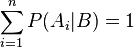
Como observación, se tiene \sum_{i=1}^{n}P(A_i |B)=1 y su demostración resulta trivial.


robado de wiki


y de aca que jodo tanto con Bayes, al tener datos neuvos se mide de nuevo, al faltar datos, se debe decir donde y ver donde medir, BTW para el Spam funciona muy bien el teorema

Bayes 1

Thomas Bayes  fue un matematico britanico . Su padre fue ministro presbiteriano. Posiblemente De Moivre, autor del afamado libro La doctrina de las probabilidades, fue su maestro particular, pues se sabe que por ese entonces ejercía como profesor en Londres. Bayes fue ordenado, al igual que su padre, como ministro disidente, y en 1731 se convirtió en reverendo de la iglesia presbiteriana en Tunbridge Wells; aparentemente trató de retirarse en 1749, pero continuó ejerciendo hasta 1752, y permaneció en ese lugar hasta su muerte.

Estudió el problema de la determinación de la probabilidad de las causas a través de los efectos observados. El teorema con su nombre se refiere a la probabilidad de un suceso condicionado por la ocurrencia de otro suceso. Más específicamente, con su teorema se resuelve el problema conocido como "de la probabilidad inversa". Esto es, valorar probabilísiticamente las posibles condiciones que rigen supuesto que se ha observado cierto suceso. Se trata de probabilidad "inversa" en el sentido de que la "directa" sería la probabilidad de observar algo supuesto que rigen ciertas condiciones. Los cultores de la inferencia bayesiana (basada en dicho teorema) afirman que la trascendencia de la probabilidad inversa reside en que es ella la que realmente interesa a la ciencia, dado que procura sacar conclusiones generales (enunciar leyes) a partir de lo objetivamente observado, y no viceversa


sigue


robado de Wiki

martes, 18 de noviembre de 2008

Sokal et altri o Tu quoque, Brute, fili mi?

Mucho hablamos, nos divertimos y usamos para denostar a los sociales con Sokal y su paper, pero, como no podia dejar de fallar, existe un programa automatic para generar papers cientificos en ciencias duras.

Pero, para que tambien lo usen los estimados

 SCIgen is a program that generates random Computer Science research papers, including graphs, figures, and citations. It uses a hand-written context-free grammar to form all elements of the papers. Our aim here is to maximize amusement, rather than coherence.

 El link?

 http://pdos.csail.mit.edu/scigen/

 el ejemplo que sigue fue publicado

 www.sciencedirect.com

 Cooperative, compact algorithms for randomized algorithms

 Rohollah Mosallahnezhad

 Iran Institute of Technology, Department of Mathematics, Hafez, Tehran, Iran

  Abstract

 Experts agree that encrypted methodologies are an interesting new topic in the field of theory, and information theorists

In this paper, we argue the appropriate unification of web browsers and Internet QoS. Our focus in this paper is not on whether information retrieval systems can be made reliable, linear-time, and Bayesian, but rather on describing new  wireless archetypes (Bots).


2007 Published by Elsevier Inc.

Keywords: Compact algorithms; Randomized algorithms; Encrypted methodologies; Internet

Y fue sacado

REMOVED: Cooperative, compact algorithms for randomized algorithms

Rohollah Mosallahnezhada,

Iran Institute of Technology, Department of Mathematics, Hafez, Tehran, Iran

Available online 19 March 2007.

This article has been removed consistent with Elsevier Policy on Article Withdrawal (http://www.elsevier.com/locate/withdrawalpolicy).

En fin

Lo habia leido hace mucho mucho, pero me hizo acordar

http://demairena.blogspot.com/ via Illuminatios

que se diviertan

miércoles, 12 de noviembre de 2008

No solo somos nosotros

Discusiones de AFJP, ANSESS etc etc ad nauseam, en fin, veamos que pasa en, digamos un paradigma, el inicial, de liberalismo y free trade, Old Albion

Regular readers will know that S2P is nothing more than a glorified Ponzi scheme or pyramid scam, where this week's National Insurance Contributions paid by employees and employers are used to pay next week's benefits to pensioners. Half a century ago, no less an authority than Aneurin Bevan - one of the founders of the welfare state - let the cat out of the bag when he said: "The great secret about the National Insurance fund is that there ain't no fund."

The reason that such an approach to providing pensions is illegal in the private sector is that it is inherently unstable. What happens, for example, if the number of contributors falls and the number of claimants rises? You don't need to be an actuary to see that the pay-as-you-go merry-go-round must grind to a juddering halt.

Nor is there anything hypothetical about that risk; it is already happening.

S2P es una especie de jubilacion estatal

Bevan es uno de los padres del Welfare State, que fue una de las causas de la derrota de Churchill en las elecciones de 1945

en fin, ya n se puede creer en nada, ah, las AFJP son piores, si, piores